

ARTAC Conference in Kinshasa, DRC
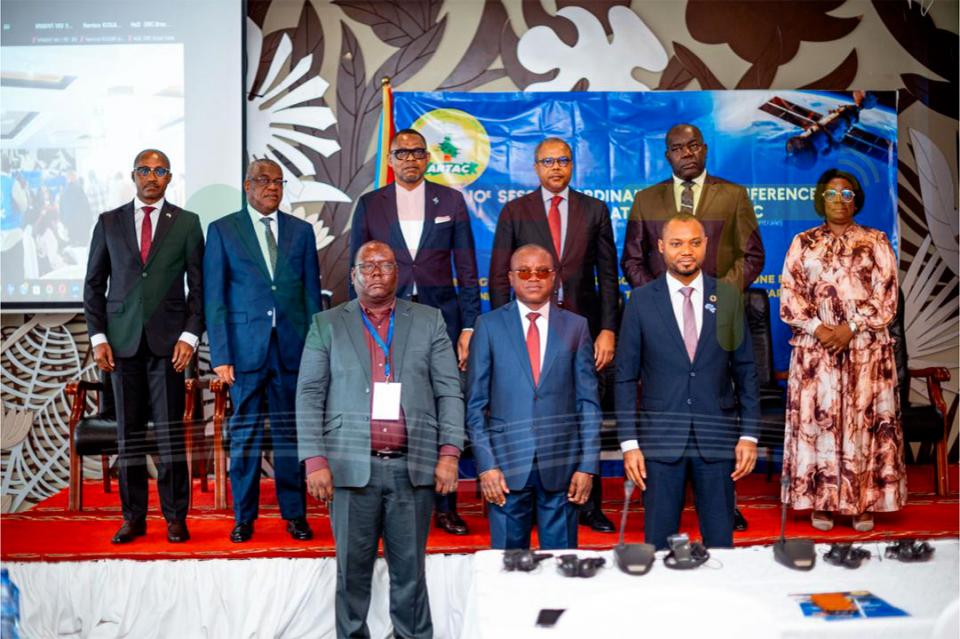
From February 16 to 19, 2026, a delegation from the Telecommunications Regulatory Board (TRB), led by its Director General, Professor Philémon Zoo Zame, took part in the 10th Ordinary Session of the Conference of Central African Telecommunications Regulators (ARTAC), held in Kinshasa, DRC. This particularly substantive session laid the foundations for a sub region that is more connected, better protected, and increasingly sovereign in the digital sphere.
One of the highlights of the meeting was the debate on non geostationary satellites (NGSO) — low orbit constellations operated by players such as Starlink, OneWeb, and Amazon Kuiper. With mobile internet penetration still below 30% in Central Africa, their potential to reach underserved rural areas is considerable. Yet their deployment raises pressing concerns: data sovereignty, risks of unfair competition for local operators, challenges to lawful interception, and possible interference with existing networks.
In a high level panel, experts called for the adoption of a harmonized regulatory framework. Key recommendations included requiring NGSO providers to establish at least one terrestrial gateway within ARTAC’s jurisdiction, subjecting them to the same financial contributions as traditional operators, and ensuring that the data of Central African citizens remain stored on the continent.
Digital financial security also featured prominently in the discussions. With the rapid expansion of mobile money and cashless payments, the sub region faces mounting threats — SIM card fraud, cyberattacks, and infrastructure vulnerabilities. Regulators endorsed recommendations from the International Telecommunication Union (ITU) to strengthen oversight and enhance user protection.
On regional interconnection, a landmark resolution was adopted: free roaming across Central Africa must become effective by June 30, 2026. If implemented, this measure will tangibly transform the daily lives of millions of travelers and business actors in the sub region.
Beyond technical issues, the 10th session also revisited ARTAC’s institutional architecture. Founding texts — statutes, internal regulations, and financial rules — were revised and adopted. The mandate of the Executive Committee was extended until December 2027, ensuring continuity in governance.
The next extraordinary session, scheduled in Libreville, Gabon, will finalize the criteria for appointing the Executive Secretary and determining the organization’s headquarters, in line with the principle of rotation among member states.
Another strong signal emerged during the opening ceremony: the signing of a roaming agreement between Gabon’s ARCEP and the DRC’s ARPTC. This concrete step illustrates the spirit of cooperation ARTAC seeks to foster across the sub region.
Established in 2004 following a resolution of the Central African Conference of Posts and Telecommunications (COPTAC), ARTAC brings together eight member states: Cameroon, Gabon, Congo, the Central African Republic, Burundi, the Democratic Republic of Congo, Chad, and Equatorial Guinea. It has since emerged as a key forum for dialogue and regulatory harmonization in a sector undergoing profound transformation.
Its mission is clear: to modernize legislative frameworks, foster fair competition, expand infrastructure, and promote universal access — with particular attention to rural areas. ARTAC also works to strengthen local expertise in the field of information and communication technologies, ensuring that the region builds both capacity and resilience in the digital age.
The active participation of Cameroon’s TRB in these proceedings reaffirms the institution’s commitment to building a more integrated, secure, and forward looking digital space in Central Africa.
ESMA